THE WUTHERING HEIGHTS DEBATE
Do film adaptations need to be accurate to be good?
Words
MARIE-CLAIRE CHAPPET
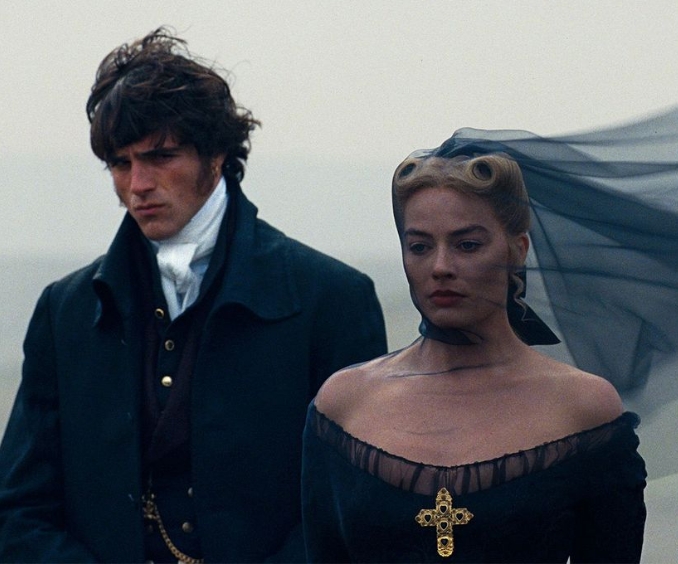
Bad wedding dresses, surreal doll houses, red vinyl! These are just some of the sticking points affronting literary purists when watching the trailers for Emerald Fennell’s Wuthering Heights. Why, they say, is Margot Robbie’s Cathy wearing a historically inaccurate marital frock? Why is Charli XCX warbling in the background? But fidelity to the source material does not always a good film – or adaptation – make.
I have more reason than most to be invested in this debate. Wuthering Heights is one of my favourite novels. I also studied it. My personal copy is a mess of dogged pages, highlighted passages and scribbles. I know this is the case for many fans of the book, who are fiercely protective of it. But I think because I know it inside out, I feel that a play-by-play interpretation of the novel may not be in its best interests. Brontë herself was forced to make compromises with the text, adding extra chapters to create a more ‘hopeful’ ending. She was also constrained by the morals of her time. But the explicit sauce in the trailer is actually there in the text if you know where to look, like a highbrow version of Where’s Wally.
Emerald Fennell’s first teaser for the film was pure smut, and the promotional artwork and style is Mills & Boon coded. (Look at the red palette, the Valentine’s Day release, the sky on fire as Jacob Elordi’s Heathcliff rears on his horse). This is not anachronistic. At its heart, Wuthering Heights is pure smut. Brontë’s novel was viewed as vulgar and depraved at the time. It is a raunchy Gothic novel with Romantic ideals; a sexy melodrama about a love too strange and obsessive to ever work in the real world. It is a book about a woman feeling like a plaything in a conventional marriage (a doll in a dollhouse!), about a man with such a consuming obsession that – spoiler alert – he engages in what is heavily implied to be necrophilia. Fennell (whose last big film, Saltburn, has an analogous grave scene) is maybe the perfect person to capture the weird and wonderful essence of Wuthering Heights.
When someone finds a new way to tell a story it often illuminates the heart of it. This appears to be what Fennell is trying to do – not changing the book, but leaning more heavily on what is already there. She has eschewed gritty realism and instead focused on the novel’s more hyperbolic and supernatural aspects. This is often the best way to reimagine a story like Wuthering Heights, which has already been adapted so many times before. Brontë’s masterpiece is, at this point, fair game, like a Shakespeare play. How wonderful is West Side Story - a beautiful 1960s adaptation of Romeo and Juliet? Or 10 Things I Hate About You? A classic teen movie moulded around The Taming of the Shrew. Both these films are totally disparate from the source material but in substance they are remarkably faithful.
Some novels need a straight retelling, like The Talented Mr Ripley. Patricia Highsmith’s thriller was already so tightly plotted and cinematic that it barely needed to change between page and screen. The Anthony Minghella 1999 version is rightfully the best. (The 2024 Netflix version suffered because it barely moved the dial. It was just more of the same.) We have just seen a curious reverse of this with Frankenstein. Earlier films barely resemble Mary Shelley’s novel; taking the idea of a monster and running with it all the way to clunky B Movie mayhem. Guillermo del Toro’s recent adaptation is the closest we’ve seen to the story Shelley actually told – true to the heart of her work in a way previous iterations utterly abandoned. It is all the better for it.
In my opinion, Wuthering Heights is too strange a book for there to ever be a truly faithful adaptation. There is a reason it is studied in schools; it thrives on multiple interpretations. It begs to be told a hundred times and in a hundred different ways. Emerald Fennell’s looks set to be the strangest yet and – given Emily Brontë dared to write a book about sex and perversion in 1847 – I think she would approve.
The best book to screen adaptations (faithful and not):
The Talented Mr Ripley (1999)
Starring Jude Law, Gwyneth Paltrow and Jude Law, the 1999 version captures the pace and the tension of Patricia Highsmith’s 1955 book impeccably, bringing it to sun-drenched life.
Clueless (1995)
A smart and witty modern update on Jane Austen’s Emma, Clueless stays true to the spirit of the novel’s sweet but guileless heroine, even if it does relocate the action to Beverly Hills in the nineties.
The Age of Innocence (1993)
This faithful adaptation of Edith Wharton’s masterpiece was directed byMartin Scorsese, who captures the violence of its repressed desire beautifully.
Cruel Intentions (1999)
The source material, Les Liaisons Dangereuses, was written in 1782, but bringing 18th-century sex scandals to the halls of the Upper East Side gives new nuance to old ideas.
Normal People (2020)
A by-the-book retelling, yes. But thanks to megawatt central performances, this BBC series brought Sally Rooney’s characters to life in a way that was even more intense than the original.
Marie-Claire Chappet is a writer and journalist. Follow her on Instagram at @mcchappet.